



How to Tune the Ukulele to Itself
The ukulele is a beautiful piece that stands alone as a unique fretted stringed instrument. Although many may associate the ukulele with the guitar, the ukulele is unique in that it lends a large portion of its sound to rhythm and beat-keeping, as opposed to the more melodic and technical sound that is characteristic of the guitar. That being said, the ukulele is a still a tonal instrument and, thus, still relies heavily on proper intonation (tuning) in completing its sound.
Adjacent String Method
A:--------0--:E:-----0--5--:
C:--0--4-----:
G:--5--------:
Non-adjacent String Method
A:-----0--3--:E:--3--------:
C:--------0--:
G:--0--2-----:
There are several ways to tune the ukulele to itself. There is a method in which you use adjacent strings to tune a string. There is also a non-adjacent string method. The non-adjacent string method is more effective on the ukulele than the adjacent string method, which is preferred on the guitar. A guitarist would probably use the adjacent string tuning method whilst attempting to tune the ukulele, while a true ukulele player will almost always use the non-adjacent method. I will explain why the non-adjacent method is more effective after I show you what exactly it is.
Before anybody attempts to do any tuning by ear, they must understand that tuning by ear is something that is only possible for SOME people. If a player cannot tune their instrument using Get-Tuned's Online Ukulele Tuner, that player WILL NOT be able to use this method. This method is what I call a "road tool", or something to resort to only when there is no other tuning method readily available. If, for example, you bring your ukulele on a camping trip, and so you can't log on to the internet to pull up the ukulele tuner, this method will allow you to tune your ukulele to ITSELF, so you will be able to play ALONE. Keep in mind that two instruments tuned with this method will not necessarily be in tune with each other, and they almost always won't be. Players in this situation will need to make sure that every string is in tune with its counterpart on the other instrument. This problem is easily solved by having one player tune his instrument to itself, and then having the other player tune each of her strings to each corresponding string on the first player's ukulele.
Now, on to the good stuff. Please keep in mind that this article is specific to standard ukulele tuning, which is:
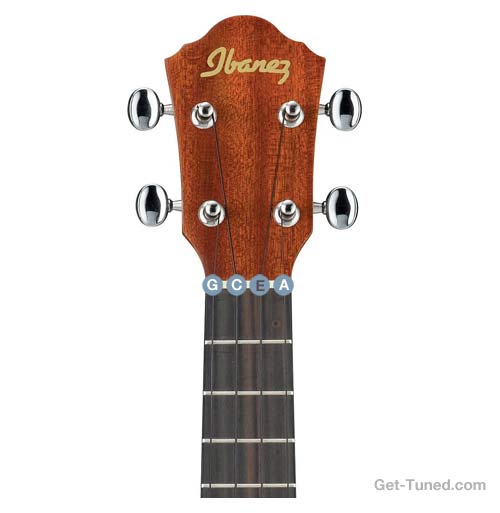
This is the tuning which most ukuleles will be in when they are on display in a shop, and it is also the tuning used by almost all beginners. For this method to work, the player must choose one string which he will arbitrarily assign as "in tune". I typically choose the E string, although technically the G and A strings tend to stay in tune best, out of all the strings. Still, for simplicity's sake, let's choose the E string, which is the highlighted above, to be our "in tune" string. Now that we've designated E as being "in tune," there is no need to tune the E string at all.
- Step 1: Using the "in tune" E string as a reference, we will begin tuning the rest of the instrument. Let's begin with the G string. The third fret on the E string will give the note G, so the player should play both the open G string and the third fret on the E string and hear the same note. If these pitches are not exactly the same, carefully but deliberately adjust the tuner attached to the G string (NOT the E string) until the pitches match. This is step one on the second figure.
- Step 2: Now that you have the E and G strings in tune with each other, you can move on to the A string. The second fret on the G string will produce an A pitch, so play this along with the open A string. If these pitches are not exactly the same, adjust the tuner attached to the A string (NOT the G string) until the pitches are exactly the same. Now we are almost entirely in tune, aside from the C string, which brings us to step three.
- Step 3: The third fret on the A string will give a C, exactly one octave above the open C string. Play both the third fret on the A string and open on the C string and you should hear an exact octave interval (same note, but one is lower pitched than the other). If the octave is NOT perfect, adjust the tuner attached to the C string (NOT the A string) until the octave is perfect.
Here is an image to help aid in understanding the process.
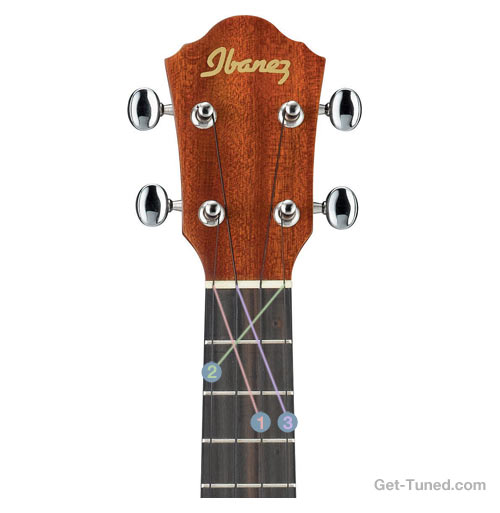
Each number on the image corresponds to the step number, and the position your finger should be in to properly produce each tone. Each number is attached to a different string by a line; this shows which open string corresponds to each fretted note. Hopefully this helps visually show what I'm trying to demonstrate.
If all three steps are done correctly, the ukulele should be exactly in tune with itself! Verify this by playing an open C chord; hold the third fret on the A string, and leave all the remaining strings open. Strum all the strings together at once, and, if properly tuned, you should hear a beautiful C major chord! (If you hear something "ugly," you've probably failed to properly tune the instrument. Try starting over!)
Different Ways to Tune a Ukulele to Itself
There are cumulatively quite a few different ways in which you can tune your ukulele to itself, and the best method to do this will often depend on the context in which you are playing. For example, if you are playing along with a guitar, you may want to tune your G-string as your initial reference string as the guitar's G-string is the exact same note in the same octave as the ukulele's G-string. Technically you can use any string as your initial reference string, and it is often best to choose the string that is the least out-of-tune, especially if you do not have a tuner on hand. In order to be able to tune a ukulele to itself using any starting string, you need to have a good idea of where all the fretted open-string notes are on your ukulele (the places to put your fingers on the frets to find the notes G, C, E and A). As the C-string is the lowest string on the ukulele, you will not find a 'C' reference note in the same octave as your C-string. You can still tune your C-string to a reference 'C' that is an octave higher - just be aware that this will sound slightly different compared to playing an identical reference note. The handy tab below shows you all the common fret reference notes for the open strings. Using this tab, you should be able to tune your ukulele from any starting reference string!
G Reference Notes
E:--3-------:
C:------7---:
G:--0---0---:
C Reference Notes
Note: Both reference notes are
an octave higher than the C-string
E:----------:
C:--0---0---:
G:------5---:
E Reference Notes
Note: A-string, seventh fret reference
note is an octave higher than the E-string
E:--0---0---:
C:--4-------:
G:----------:
A Reference Notes
E:------5---:
C:----------:
G:--2-------:
Tuning your Ukulele using 'Middle-C'
Start by getting the C-string as close to in-tune as you can by ear, and then tune the rest of the ukulele strings off the C-string. The ukulele will then be in tune with itself, and it will sound in-tune, even if every string is a little sharp or flat.
Using the image above as a reference, tune your ukulele using the following steps:
-
Make sure that your C-string is in tune (either by using a tuner, tuning from 'middle C' on a piano, or by tuning the C-string as close as you can by ear).
-
Put a finger on the fourth fret of your tuned C-string. The note you are holding down is 'E' - the exact same note as your E-string! Use the reference 'E' (the one you are holding down with your finger) to tune your E-string until the two notes sound the same.
-
Now that your E-string is in-tune, you can use this string to help tune your other strings. Put a finger on the third fret of your E-string. The note you are holding down is 'G' - the exact same note as your G-string. Again, use your reference G to tune your G-string.
-
To tune the final string (the A-string) put a finger on the second fret of your G-string. This note is 'A' and you can use it to tune your A-string.
E:--0---3------:
C:--4----------:
G:------0---2--:
As a general rule, it is best to tune to the reference note that uses the lowest fret possible. This is for several reasons. Most ukuleles are constructed economically, meaning that the fretting of the instrument isn't always exactly perfect. Also, the nylon strings of the ukulele allow the player to adjust the pitch of a fretted note simply by adjusting the amount of pressure being put onto the string (or by stretching the string slightly to one side). These characteristics of the ukulele can cause tonal distortion. The possible impact of tonal distortion increases as the player moves further up the fret board, towards the body. So the further you are fretting from the head of the uke, the more out-of-tune each note will be. When fretting reference notes closest to the head of the ukulele, you are minimising the impact the tonal distortion will have on your tuning.
To see other methods on how to tune the ukulele visit our How to Tune the Ukulele page.



Violin Girl
Most Fiddlers can tune by their axe by bowing the open string pairs tuned Fifths. The sound is idiomatic.There is no reason a similar technique cannot be learned and employed on Ukulele ( which is not about fleas but Hawian for gifts. )The fleas comes from the traditional tuning mnemonic used by the vaudeville pros of the 20s. My dog has fleas song tuning method. No fretting at all. My Bonny lies over the ocean method only fret at the very first position, so intonation is very faithful. But learn the “my dog has fleas” tune of the open strings. If you can hear one song and differentiate it from another, you are all entirely capable of tuning the the little hatchet by ear. PROMISE.
Learn to Sight sing it in
My Dog has fleas is a little tune all the 1920s pros learned to get the little suckers in tune. You can then use the E/G method to check intonation.
Learn to sing the intervals. C to E is a major third (MICHAEL(C) ROWED (E)his boat ashore) C to A a Major 6th (MY(C) BONNY(A) lie over the Ocean) That’s 3 strings tuned. BUT the song “My Bonny lie over the Ocean” is a song that can tune the entire Hatchet by fretting the E 1st Fret, gives you F, the “Over” note. So if you then pluck the C (My) then the A (Bonnie) then the G ( lies) E 1st fret (Over). This with a little practice gets the the little horn perfectly intoned as any fretted not is suspect ( I can beat electric tuners this way in accuracy and speed and you only fret one note) Good relative pitch is enough and all can develop it and should if they decide to play music, be a musician. Because the tuning is recumbent the instrument tunes very well this way. But modern people are often, let’s say politely, in a hurry. Then I suppose impolitely, don’t do very much WELL. Even at many stores I know more about the place after a casual stroll than most folk serving (JB Hifi Canberra a wonderful exception ! Great job fellas)
Be your best. You can do anything with determination and don’t let anyone put you down and say you can’t!
Advanced Online Ukulele Tuner
This online ukulele tuner offers 13 different ukulele tunings. All standard and many alternates.
https://ukesong.com/online-ukulele-tuner/
Worth taking a look
Helpful
This is the best description and comparison of Uke tuning methods I can find...I found this site because I was looking for an alternative method to the normal "adjacent string" method. That method is taught in uke books but it doesn't have a good result (makes my open c string very flat). I like the non-adjacent string method starting with the E string, 3rd fret to open G. That works well for my uke. However, following the step by step directions for ANY of the fret-matching tuning methods can be tricky. I am going to recommend that my beginning level students download uke tuning apps on their phones, or tune to their keyboards.
jjujh
How do you tune it
hi
Armovic
thank you! it was good for me to get into use of this site, it helped me at all.
Armovic
thank you! it was good for me to get into use of this site, it helped me at all.
@@@@@@@@@2
HOW DO I TUNE MY UKE
i no
this is so BAD!!!!!!!!!!!!!!!
This is very helpful but hard to remember
Thank you . I was lost until I found this site. Now I can get started. This was extremely easy to follow the instructions.
Awesome, I never knew you could do this.