



How to String a Violin
Changing the strings on your violin can be a daunting task. But rather than spending time and money getting a luthier to restring your instrument, you can replace them yourself with this step-by-step guide. Learning to restring a violin is a valuable skill. After stringing your violin a few times, you should be able to restring a string when you inevitably break one and be playing again in less than ten minutes.
- What Strings You Should Use
- How to String a Violin
- When Should You Change Your Violin Strings
- How Often Do Strings Need To Be Replaced
What Strings You Should Use
Before we get onto how to string your violin, it is important to choose appropriate violin strings. When you buy strings, buy ones that suit your level. There is little reason for a beginner to play on $100+ strings, but at the same time, you will not get the same sweetness of sound using very cheap, poor-quality strings.
When it comes to violin strings, you get what you pay for. Cheap strings will break more easily than more expensive strings. They also tend to stretch unreliably, causing the string to start to unravel soon after being put on the violin.
Have a look around for a brand of strings that suits you. Some strings are made out of catgut, which is an old term used for strings made of animal intestines. These days' catgut strings are usually made out of sheep or goat intestines rather than cat. Catgut strings are always well labeled and are usually quite expensive. If you do not feel comfortable using catgut strings, then there are definitely other good quality metal options available.
How to String a Violin
Make sure to restring strings one at a time. Restringing one at a time means you will never get confused about what string goes on what peg and you will have the other strung strings to look at as a guide.
Parts of the Violin You Need to Know
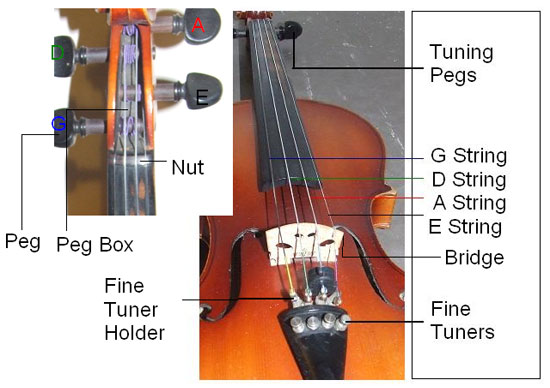
It is important that you know the names of the different parts of the violin that you will interact with while restringing your instrument. Have a close look at your violin - the nut (at the top of the violin under the peg box) and the bridge both have notches in them where the string rests to make sure the strings are evenly spaced. The tail piece has small arms attached to hold the ball end (or nub) of the string in place, while the peg has a small hole for the string to be threaded through. These are all small but important parts of the violin that you will need to be familiar with.
Restringing Steps
Step 1 - Winding the Peg
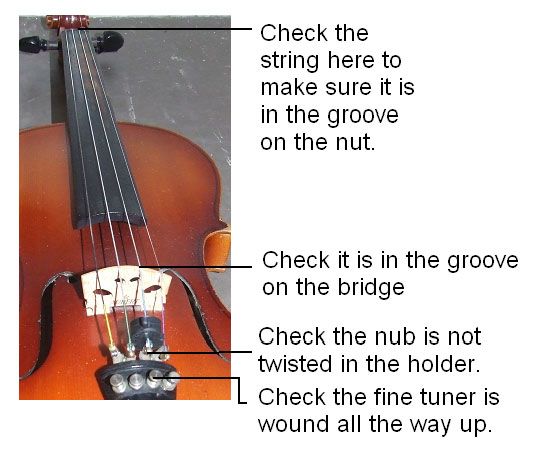
First, unwind the fine tuner so it can be used once the string is attached. The fine tuner should be wound out to the point where it starts feeling loose, and then wound in a little so that it does not fall out.
Place the nub (or ball end) of the string into the arms on the tailpiece, making sure the nub is the right way up - with the string coming over the top. Having the nub the other way round causes extra stress on the string and can bend the string and cause friction, leading to breakages.
With the nub or ball end in the holder, it is time to focus on the peg end of the string. Bend the peg end of the string over about 1-2cm from the end of the string, so that it forms close to a right-angle. This will help you to thread the string through the hole in the peg, and will help the string to stay in the hole when you wind the peg. Thread the string though the hole in the peg, and turn the peg towards the scroll so that the hole that you threaded the string into is facing the scroll. This makes sure that the string is sitting in the peg securely.
With your hand pulling down gently on the string to maintain enough tension to ensure that the string is wound evenly, angle the string away from the peg (by holding the string towards the opposite side of the fingerboard to the side that the peg is on) and wind the string around the peg for 2 turns. The string should wind on the peg on the opposite side of the peg hole from where the head of the peg is. Then, cross the string over to the other side, (by angling the string towards the peg side of the fingerboard) and continue winding. The string should cross over the previous 2 coils and wind up on the peg side of the peg hole. There it should continue to wind neatly towards the peg. Keep winding until the string sits with enough tension to keep it in the tailpiece without having to hold it in place. We wind the string this way so that as the string loosens up, it has enough space to neatly wrap around the peg and so that the string won't be bent unnecessarily.
If you have trouble turning the fine tuner screw or peg, there are tips on how to alleviate this problem in our Violin Maintenance Guide.
Note when stringing the E string: The E string is so thin it often cuts into the wood of the bridge. To prevent this, many E strings will have a small plastic tube on the string, and some bridges are reinforced under the E string notch. The plastic tube on the E string is meant to be placed over the part of the string that touches the bridge. Always place the plastic tube with the excess plastic hanging towards the tuner side to stop the plastic from interfering with your playing.
Step 2 - Checking the length of the String
Check the length of the string to make sure it is in the right place. Make sure you check the tailpiece end, at the bridge to make sure the string is sitting in the right notch, and at the nut end of the string to make sure it is properly in place. Wind the string in until it is firmly in place, but still under the pitch of the note you need to tune your string to.
Step 3 - Tuning the string
Use the peg to tune the string to as close to the note as possible, while still remaining slightly below the note. Then, use the fine tuners to adjust the note, as explained in the How to Tune the Violin article.
The string will stretch rapidly to start off with and it will need tightening at the peg often. This is because the fibers in the string stretch as the string is tightened. Play the string as much as you can over the next few days to get all the stretching and retuning out of the way so you can then play the string without constantly slipping out of tune.
When Should You Change Your Violin Strings
You should replace strings as soon as they start to wear. A sign that your strings may be getting old is that they will start to unravel. Strings that unravel make the violin sound fuzzy and can also cause scratches in the fingerboard. Also old strings will lose their tone and will sound dull. If your strings are losing their resonance and playability especially while using vibrato then it is time for a new set of strings.
How Often Do Strings Need To Be Replaced
It varies how often you should change the strings on your violin according to how well you maintain it and how much you play. As a general rule if you play 1 to 2 hours a day you should restring your violin every 3 to 5 months. If you are a beginner and your lack of skill overshadows the quality of resonance your strings have then it is not as important to change them that frequently, but at least once a year. As you become better and are performing more, it is important to have the best tone as possible. Consider changing your strings a couple of days before a big performance, giving you a couple of days to break them in.



Very clear instructions. Thank you.
beginner
thNK YOU FOR THE HELP
Should the string be left in the tense mode when not in use or storage ?
Your instructions are great. Could not have done it without you. I don't play, wish I did. I really appreciate fine wood working. It is beautiful.
Thanks & Regards
I inherited a hand-made violin made by my great uncle in 1902. It's my treasure. I have the original case but will display it on my piano. My husband made a beautiful stand for it and its bow. So your instructions and pictures are just what I need to complete the project. Thank you!!
How to identify violin string
I sincerely appreciate the details on how to restring a violin but I have the problem of identification. eg. Which number of string do i fix on G or D bcos the strings are numbered. Thanks.
4/5
wish there were more photos but other than that it was good
Thank you
Pictures wuld be nice.
When replacing a violin string, is there a problem if the string
winds on the peg beyond the wound portion of the string where the
bare string then touches the ebony peg? Yes I am sure I rewound on the correct peg in the peg box.
pictures
Adding 'steps' in pictures would be nice.
Should have read this before I tried to do it. :/